Detect subject, business/site type and publishing format first. Candidate domains remain research candidates until a real comparison verifies overlap.
SOCIALKIT COMPETITOR INTELLIGENCE
GfGapForge
Find the gap.
Build the better page.
Start with your own URL. GapForge first builds an exact sub-niche fingerprint and detects the site subject/content format — for example news, blog, video-led publisher, tools, store or a dynamic unknown niche — then suggests only strict same-niche competitor candidates (up to 10; fewer/zero is allowed) and switches any selected domain into a two-site bounded public-HTML comparison. The competitor crawl is then topic-focused using repeated own-site phrase evidence. After fetch, a strict niche/model gate re-checks both sites; a mismatch stops the comparison instead of manufacturing gaps. See your weak points, competitor weaknesses, repeated topic-phrase differences, internal-link signals, sample completeness and a visual roadmap for what to fix, verify, research, build and defend next. GapForge keeps single-page/noisy words out of BUILD recommendations.
✓ Strict exact-sub-niche gate✓ Open-world subject detection✓ News / blog / video formats✓ Discover 10 candidates✓ Switch & compare✓ Competitor weakness map✓ Repeated phrase gaps only✓ CAPTCHA/WAF-aware errors✓ No fake traffic score
WHAT GAPFORGE IS GOOD FOR
Turn competitor pages into evidence-backed decisions — without copying them.
GapForge is most useful when you need to choose a relevant competitor, verify what the server could actually read, separate confirmed problems from manual-review signals, and turn repeated content differences into a measured research plan.
See confirmed crawl/technical failures separately from review-only signals before spending time on new content.
Only sampled mechanical failures are called confirmed weaknesses. A review item is never promoted to a failure.
BUILD candidates now prefer 2–3 word title/H1/heading phrases supported by at least two competitor pages—not loose words such as “track”, “right” or “content”.
The action-readiness gate pauses topic recommendations when the competitor is unrelated, blocked, too thinly sampled or only weakly supported.
Source URLs, request logs, sample counts and fetch diagnostics stay visible so users can audit the audit.
Connect own-site Search Console and licensed keyword/backlink/SERP providers when you need real clicks, impressions, demand or link evidence.
Save projects and run deeper scheduled public-HTML snapshots for change tracking instead of treating one comparison as permanent truth.
Real-result boundary: GapForge can verify public HTML it successfully fetched. It cannot know a competitor’s private traffic, conversions, Search Console, backlinks or search demand unless a licensed/authorized data source is connected.
GAPFORGE PROFESSIONAL INTELLIGENCE
One comparison is useful. A monitored intelligence system is stronger.
GapForge Pro keeps public-HTML evidence separate from real performance/provider data, so a missing connector never becomes a fabricated metric.
Own clicks, impressions, CTR, queries and positions.
Licensed provider bridge for real demand validation.
Referring-domain and link-gap intelligence provider.
Scheduled multi-sample crawl up to 50 pages/site.
Persistent competitor sets and comparison baselines.
Daily, weekly or monthly snapshots and change alerts.
Provider bridge for ranking and AI-answer presence.
Accuracy rule: raw HTML, Search Console, licensed provider data and rendered-JS evidence are labeled separately. GapForge does not fill disconnected layers with estimates.
PROFESSIONAL WORKSPACE · VISIBLE BEFORE YOU RUN
The professional intelligence layer is here.
Run a comparison to activate project-specific controls. External metrics only appear when their server-side connector is configured.
Google Search ConsoleConnector-ready
Real own-site clicks, impressions, CTR, positions, queries and pages.
Keyword demandProvider bridge
Licensed search-volume and difficulty data when configured.
Backlink intelligenceProvider bridge
Referring-domain and competitor link-gap evidence.
Deep monitoring20 / 30 / 50 pages
Scheduled deeper public-HTML snapshots for saved projects.
Saved projectsPersistent workspace
Keep competitor sets, baselines and monitoring settings attached to your account.
Automatic monitoringDaily / weekly / monthly
Track meaningful competitor changes through the host cron worker.
SERP / AI presenceProvider bridge
Ranking and AI-answer presence when a licensed provider is connected.
How to activate the controlsEnter your URL → discover/select a competitor → run comparison. The full Save Project / Deep Monitor / Live Intelligence workspace appears at the top of the report.
Start comparison ↓DISCOVER → SWITCH → COMPARE
Start with your URL. Find the right competitors.
Discover up to 10 strict same-niche candidate domains, run a strict same-niche deep comparison of up to 5, 10 or 15 readable public HTML pages per site, then save the result as a project for deeper scheduled monitoring and connected intelligence. Partial or blocked competitor samples stay clearly labeled.
GAPFORGE / COMPARISON REPORT
Competitor comparison
GapForge Pro Intelligence · Product walkthrough
Full HD · SilentInspect a competitor comparison before starting your own.
The short recording previews a comparison report. Use the steps below to prepare a relevant comparison and interpret its findings.
Silent recording. Use fullscreen for a closer look. Video loads when you press play.
Explore the details
View report reference ↗Supporting reference for this walkthrough
This is a recorded example. Competitor findings depend on accessible pages and the evidence available at the time of your run.
Recorded example. Your inputs and results will differ. Current plans and limits apply; some recorded interface labels may be older.
REAL RESULT EXAMPLE
From competitor discovery to evidence-backed actions
Use these example report views to understand how GapForge separates candidate fit, comparison readiness, professional intelligence controls, supported gap evidence and the final action path.
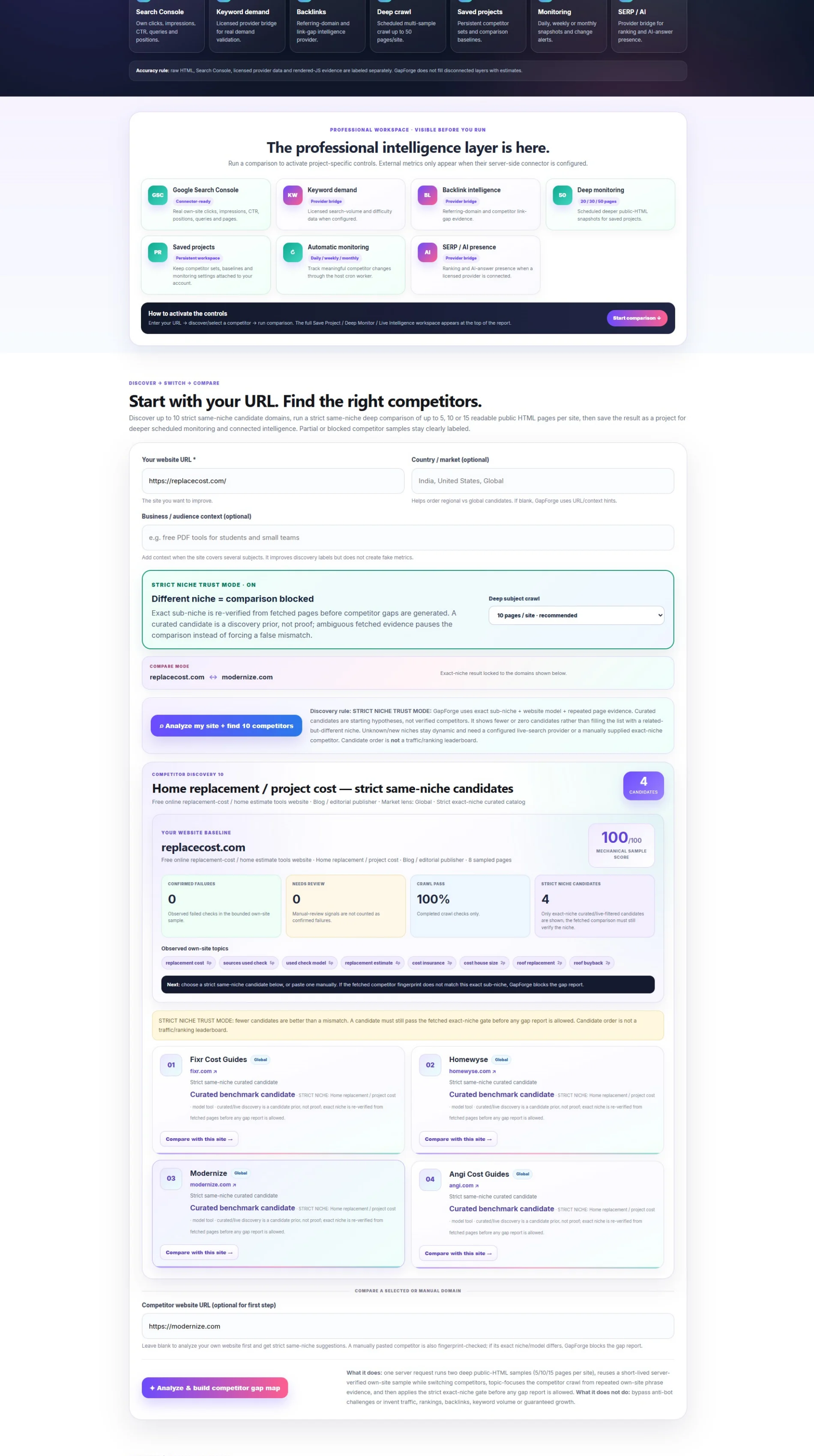
Discover
Start with your URL and shortlist a relevant competitor.
See the own-site inputs, strict niche-trust state and candidate cards together before deciding which domain is worth comparing.
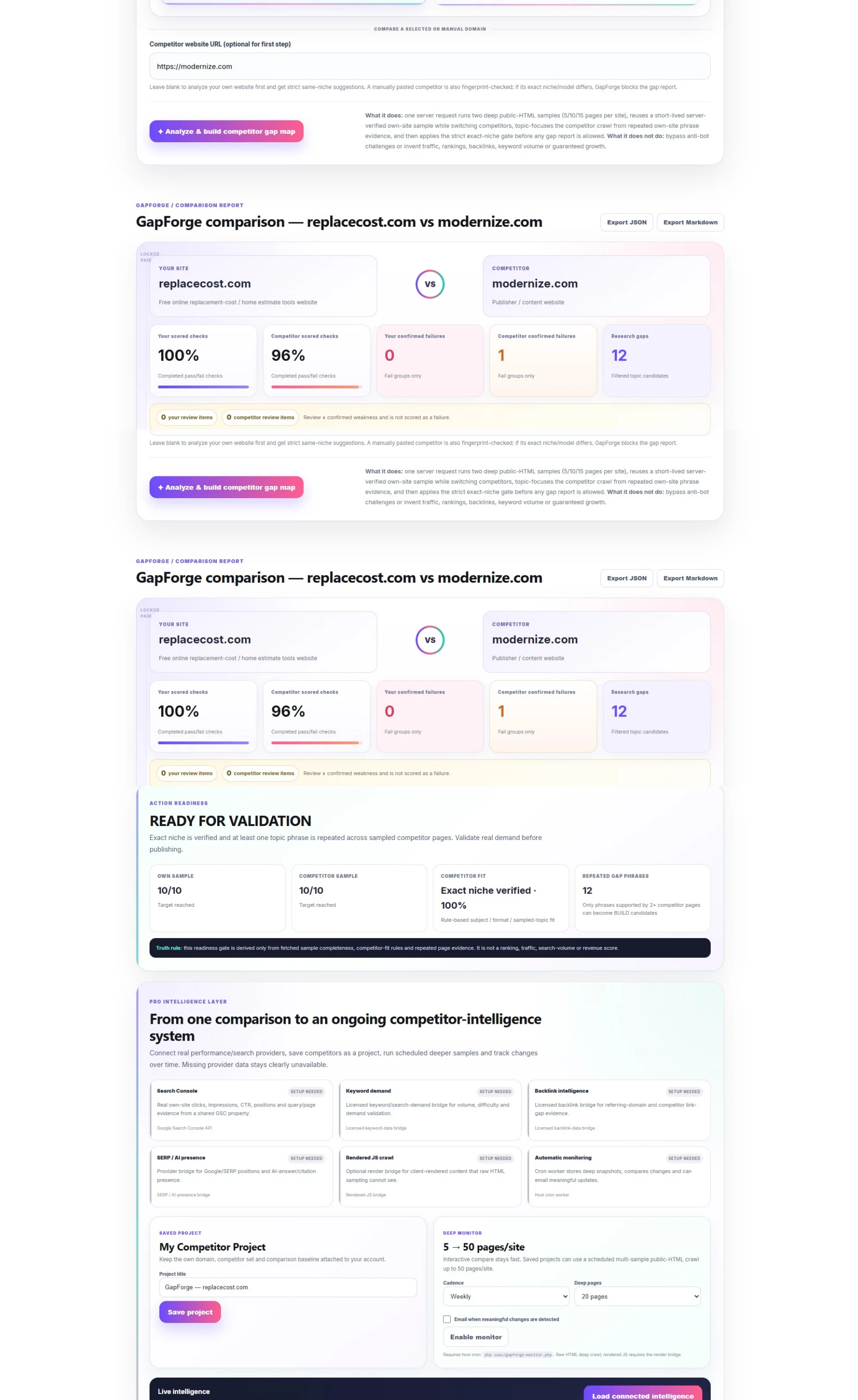
Compare
Check the comparison summary before acting on gaps.
The comparison view keeps sample quality, verified niche fit and action-readiness signals visible so weak evidence is not presented like a confident opportunity.
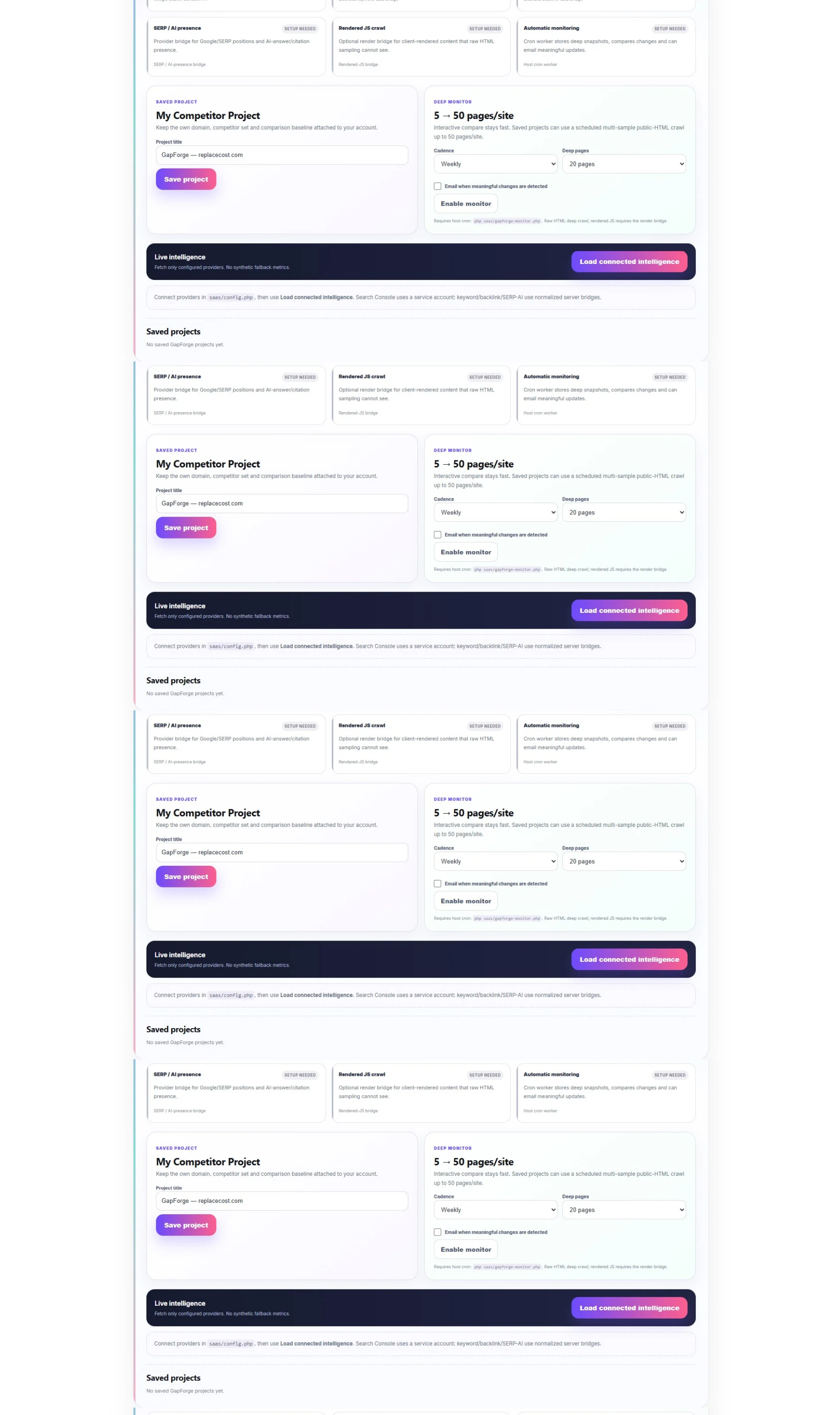
Extend
Keep the comparison attached to a project when deeper research is needed.
Project controls, deeper page sampling, monitoring and connected intelligence stay clearly separated from the public-HTML comparison.
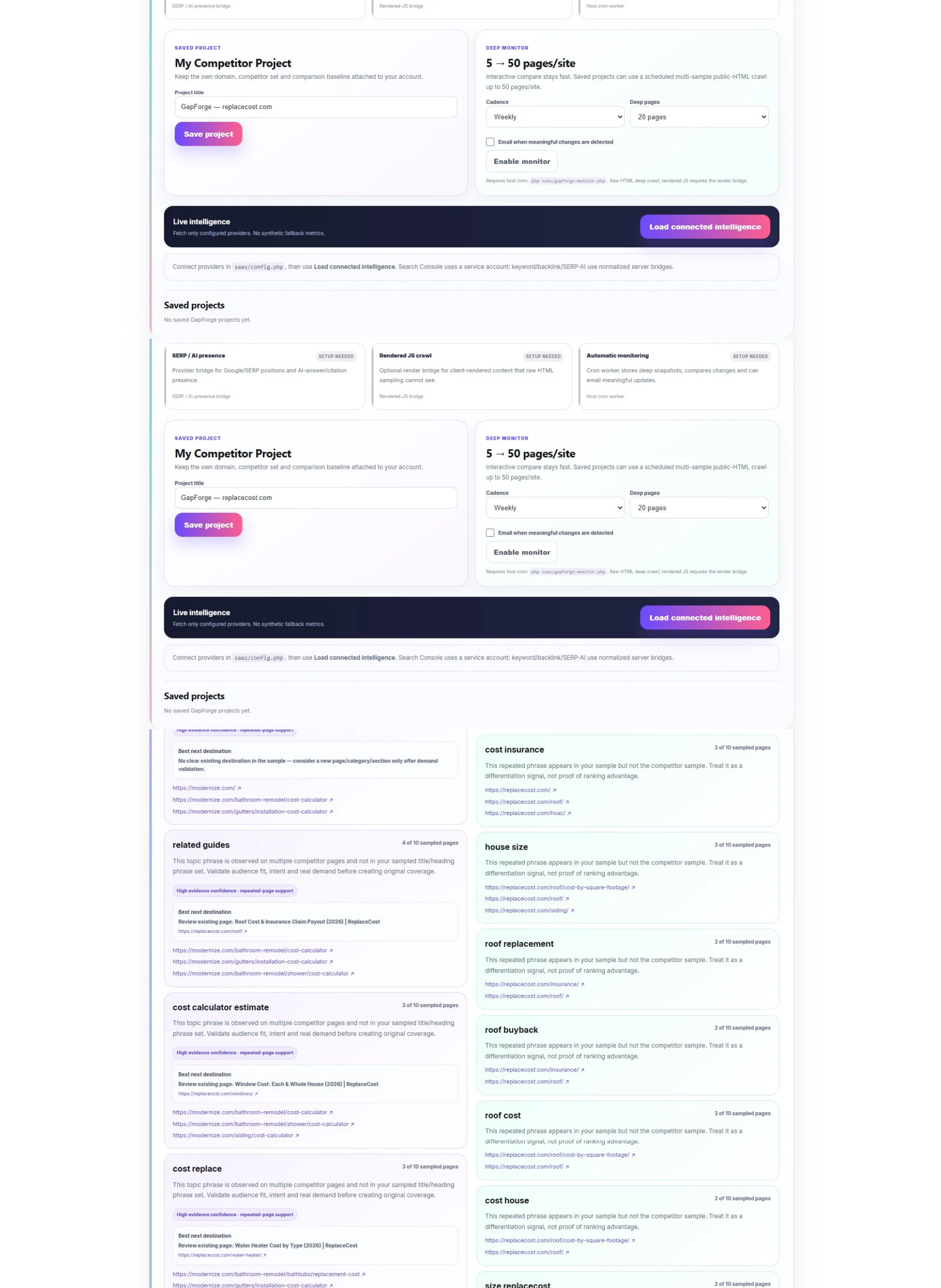
Verify
Inspect the evidence behind weaknesses and topic differences.
GapForge keeps observed evidence, review-only signals and supported research candidates separate so you can verify the source before building anything new.
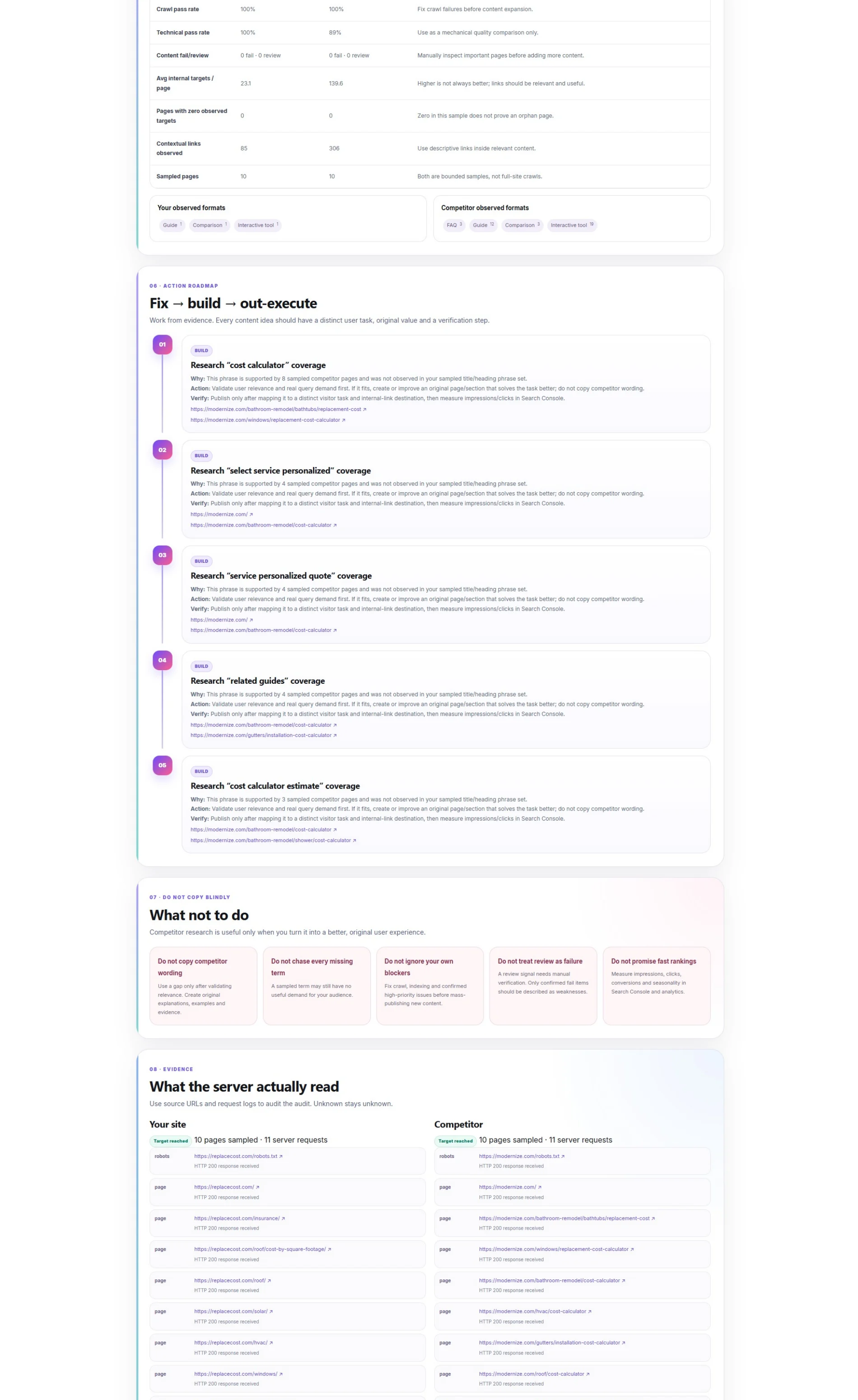
Act
Finish with the action path and the pages the server actually read.
The final views help you separate what to fix now, what to verify, what to research further and which sampled pages support the comparison.
Evidence before recommendationsGapForge keeps uncertain or incomplete signals from becoming automatic BUILD tasks.
One workflow, several evidence layersPublic HTML, connected performance data and monitoring remain labeled by source.
Built to support decisionsThe result is structured around verification and next actions rather than a single opaque score.
USE THE GAP, NOT THE HYPE
How to turn competitor research into better work
GapForge separates confirmed failures from review-only signals so you can investigate competitors without turning uncertain evidence into fake weakness claims.
Can GapForge understand news sites, blogs and video-led blogs?
Yes. The open-world classifier separates subject from publishing format, so a politics newsroom, sports blog, technology news site or travel video blog can be labeled by both topic and format. If a niche is not in the built-in taxonomy, GapForge creates a dynamic subject from repeated page evidence instead of forcing a wrong category.
Are the 10 suggested competitors a live traffic-ranked Top 10?
No. They are best-fit research candidates based on detected subject/site type and optional live-search results. Verify direct competitive overlap before comparing them.
Why can a site show 100% scored checks and still have review items?
The percentage uses completed mechanical pass/fail checks. Review items are excluded from the score, so they are shown separately and are not counted as confirmed failures.
Does GapForge tell me exactly why my competitor gets more traffic?
No. Public HTML can show quality and coverage signals, but actual traffic causes require rankings, query data, backlinks, brand demand, distribution and analytics evidence.
What should I do with a filtered topic the competitor has and I do not?
Validate audience relevance, intent and real demand. If it fits, build original coverage with stronger clarity, examples, trust signals and internal links. Do not copy wording or structure blindly.
What is the fastest safe sequence?
Fix confirmed failures on your own site first, manually verify review items, improve important landing pages, research high-fit gaps, build original supporting content, and measure the effect in Search Console and analytics.
Can a competitor weakness become my advantage?
Yes as a quality benchmark when the weakness is a confirmed failed check. Review-only signals are investigation leads and should not be treated as proven competitor problems.
Can GapForge use real Google Search Console data?
Yes. Configure the server-side service account and share the own-site Search Console property with it. GapForge then shows measured 28-day query/page evidence instead of estimates.
How do saved projects and monitoring work?
Paid logged-in users can save a competitor project. After a Hostinger cron job is configured, GapForge can run daily, weekly or monthly deeper snapshots, keep history and optionally email meaningful changes.
Does deep mode render JavaScript?
The scheduled deep crawler reads public HTML and can merge samples up to 50 pages per site. Client-rendered content needs the optional render bridge; GapForge keeps raw HTML and rendered evidence separate.
Why does GapForge no longer show loose gaps such as “track”, “right”, “studio” or “content”?
Those are generic one-word observations, not reliable content opportunities. GapForge prefers 2–3 word title/H1/heading phrases and requires repeated competitor-page support before a phrase can become a BUILD candidate.
What if SocialKit or the competitor shows a CAPTCHA or security challenge?
GapForge does not bypass CAPTCHAs, WAFs or bot challenges. If the SocialKit API itself is intercepted by a verification page, the browser now reports a security-verification error instead of trying to parse the challenge HTML as a comparison result.
What happens if I paste a website from a different niche?
STRICT NICHE TRUST MODE blocks the competitor gap report. GapForge shows the detected exact niche/model mismatch and keeps only your own-site evidence plus fetch logs. It does not create competitor weaknesses, topic gaps, differentiators or BUILD tasks from that mismatched pair.
Does 15-page mode mean a guaranteed full-site crawl?
No. It is the deepest interactive subject-focused sample. GapForge only says full small-site coverage is verified when every discovered crawlable URL in that small sample is actually read. Larger sites remain clearly labeled as deep or partial samples.
Can a curated same-niche candidate still be paused?
Yes. A discovery card is a candidate prior, not proof. If fetched pages are ambiguous or too generic, GapForge shows Niche unverified and keeps BUILD paused instead of falsely calling the site a mismatch or a verified competitor.
How does GapForge handle same-niche sites that use different wording?
It uses task-equivalent evidence rather than exact marketing phrases. For home project cost sites, examples include replacement cost, cost to install, cost to repair, installation cost, labor/material cost, project estimates and cost guides. Strong equivalent evidence can verify the same niche.
CREATOR ACADEMY · GAPFORGE
Learn competitor research before you act
Use the guide for workflow, the strategy article for deeper planning, and the FAQ when a result label or limitation is unclear.
FREE GUIDE · PROOF & TRUST
Grow without buying backlinks
Use same-subject competitor research to find useful questions, then build your own evidence and measure the change.
GUIDEGapForge competitor gap guide
Discover candidates, switch domains, interpret confirmed failures and build a Fix / Verify / Build / Defend roadmap.
ARTICLECompetitor gap strategy that avoids copying
How to turn competitor research into original pages, stronger internal links and measurable experiments.
FAQGapForge result FAQ
Understand candidate priors vs fetched proof, verified / unverified / blocked niche states, score vs review, topic gaps and evidence limits.
FREE PLAYBOOKChoose the right competitor & validate real gaps
A step-by-step Creator Academy playbook for three-way niche verification, repeated phrase evidence, source verification and Search Console measurement.