UNIFIED · research + live-page audit

Keyword Intelligence Studio

Discover live search phrases, audit a published page against its target keyword, or scan for stuffing and hidden-text risks. Pick the workflow you need below—without hunting through duplicate tools.

Keyword Intelligence Studio (2-in-1)Your tool. Connected workflows.
Real workspace demo

See Keyword Intelligence Studio in action.

Watch the real workspace move from keyword discovery to a live-page audit and an integrity check. Then use the result previews below to understand what each workflow returns.

✓ Real Keyword Research workflow ✓ Live Website Page Audit example ✓ Spam & Integrity result preview
Real result preview

See what the workflows return before you run your own check.

These examples are captured from the real Keyword Intelligence Studio interface so you can recognize the input, result and next-action areas when you use the tool yourself.

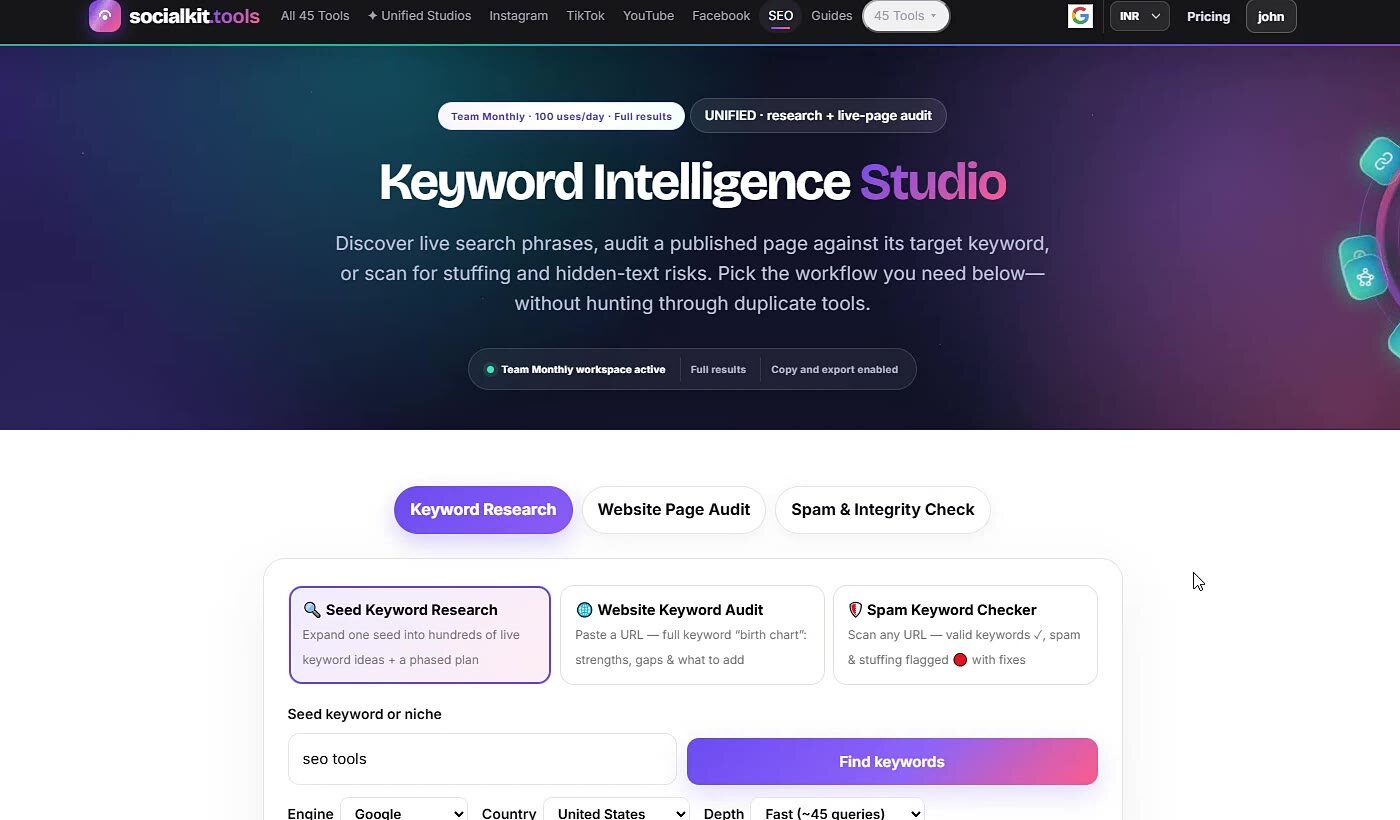
Keyword Intelligence Studio seed keyword research input example
Keyword Research

Start with one seed and choose your source.

Enter a topic or niche, select the engine and research depth, then run the search to expand the seed into live suggestion groups.
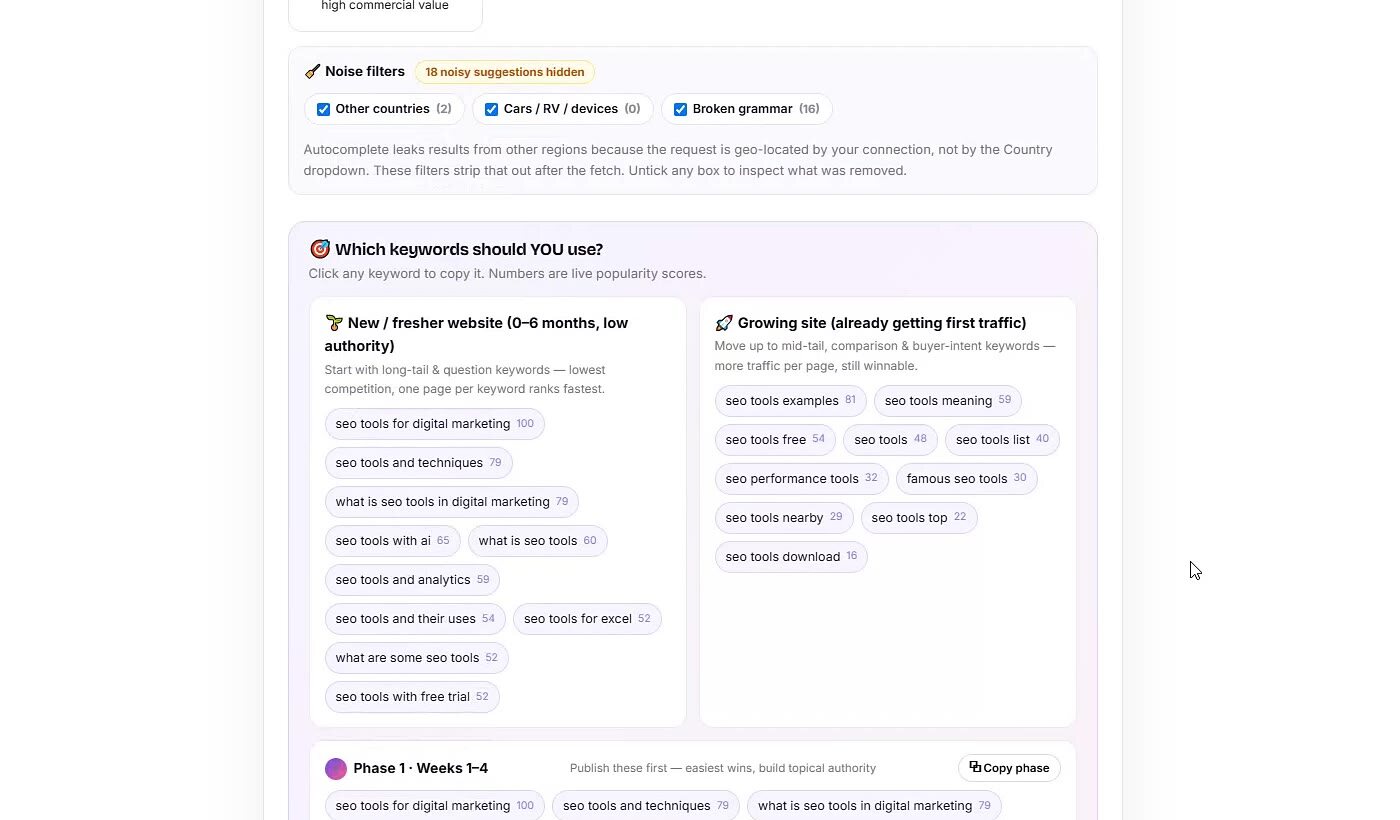
Keyword Intelligence Studio keyword result recommendations example
Research Result

Turn the list into a practical keyword plan.

Review grouped recommendations for newer and growing sites, then use the phase suggestions to decide what to work on first.
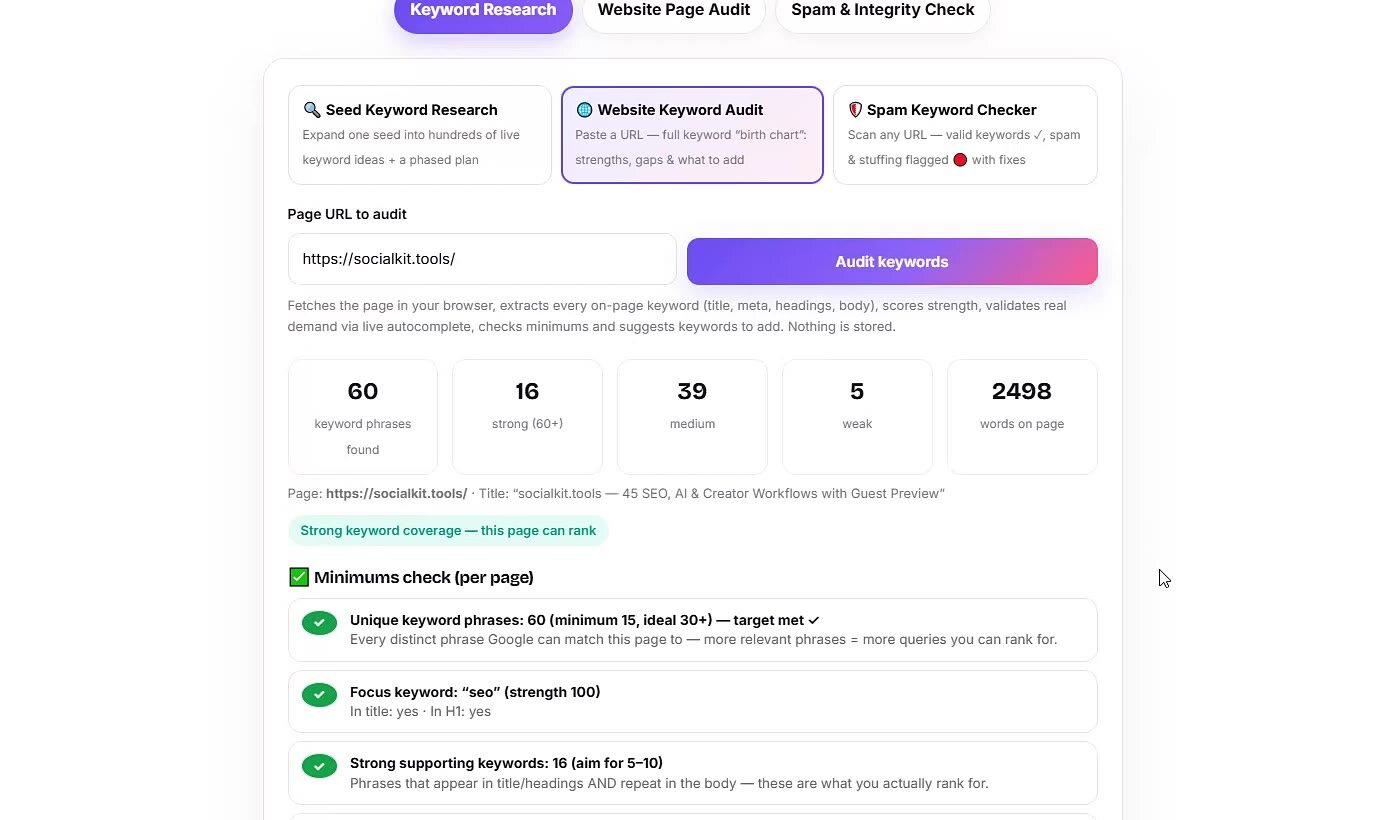
Keyword Intelligence Studio website page audit result example
Website Page Audit

See coverage, strengths and gaps on a real page.

After you paste a URL, the audit summarizes keyword phrases, stronger and weaker areas, page size and the checks that need attention.
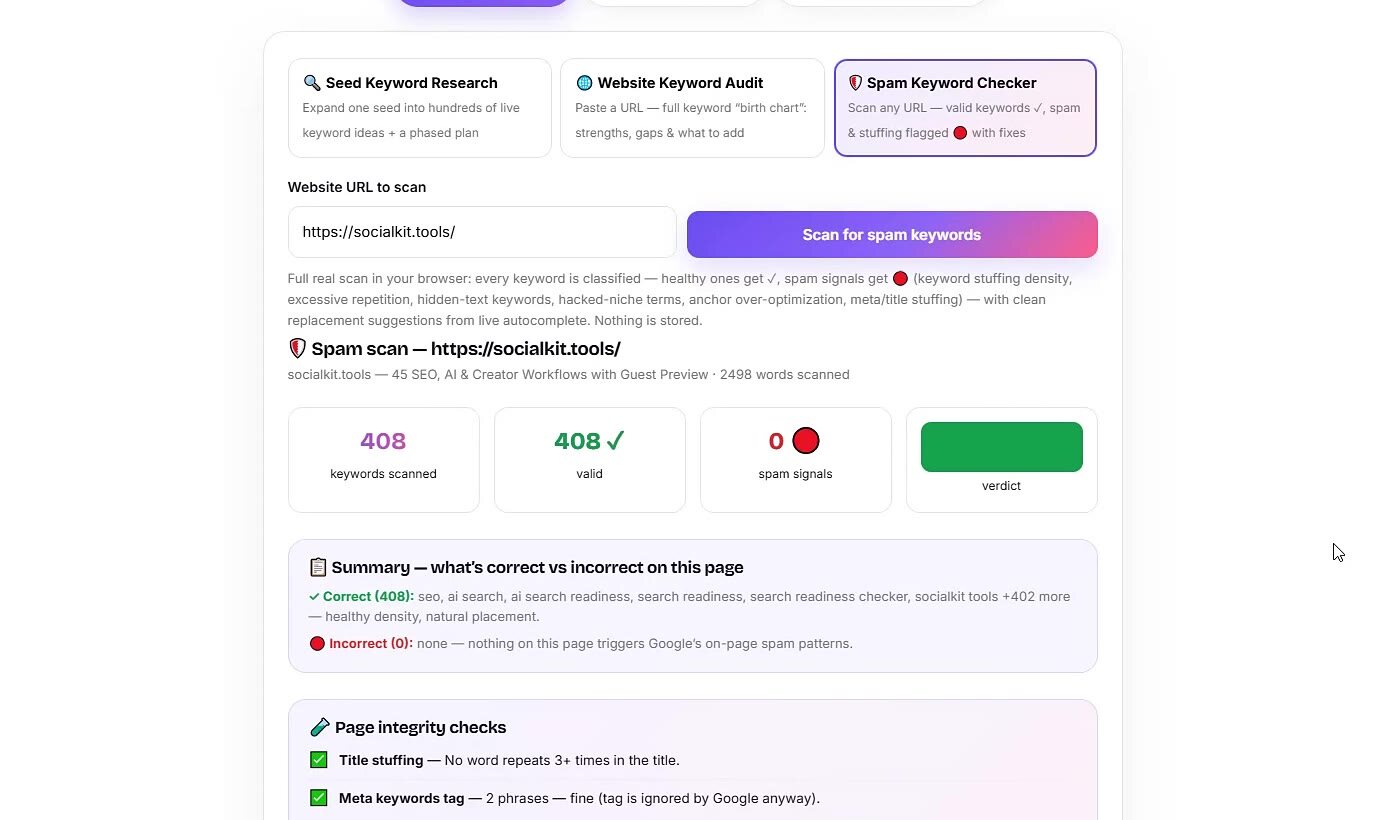
Keyword Intelligence Studio spam and integrity result example
Spam & Integrity

Separate healthy usage from suspicious signals.

The result summarizes scanned keywords, valid terms, spam signals and page-integrity checks so you can inspect anything that needs review.

Example results: the values shown here come from the recorded example. Your own output will depend on the seed, URL and page content you provide.

Choose the right SEO workflow

Each mode has a distinct job, input and report—combined here because they belong to the same keyword decision process.

It fires dozens of expansion queries at the live autocomplete API of your chosen engine — the seed alone, seed + every letter a–z, question words in front, prepositions and buyer modifiers around it (Deep mode adds numbers and 20 commercial modifiers). Every returned suggestion is a phrase real people are typing today. Duplicates are merged, each keyword gets a popularity score from its autocomplete rank and how many variants surfaced it, an intent label, and a question flag — then it all lands in a filterable, sortable, exportable table.

  1. Enter a seed keyword — a niche, product or topic (“resume builder”, “dog training”).
  2. Pick engine, country and depth — Deep mode runs ~130 expansion queries for the biggest list.
  3. Watch the live progress bar — suggestions stream in from real autocomplete data.
  4. Work the tabs — Questions for AEO content, Buyer intent for money pages, Long-tail for easy wins.
  5. Export — CSV with popularity, intent and word counts, or copy the plain list.

Which keyword tab should you use for what?

Each tab maps to a content strategy: Questions feed answer-engine and FAQ content, Comparisons capture people choosing between options, Buyer-intent phrases belong on product pages, and Long-tail phrases are the lowest-competition wins for a new site. The table below shows the mapping at a glance.

TabPatternBest used for
AllEvery unique suggestion foundTopic mapping, content calendars
Questionshow / what / why / can…FAQ sections, AEO answer pages, featured snippets
Comparisonsvs, alternative, compareHigh-converting comparison posts
Buyer intentbuy, price, best, reviewProduct and landing pages
Long-tail4+ word phrasesLow-competition blog posts

Most keyword research tools charge for stale volume data; this keyword research tool free version reads live autocomplete instead — the exact phrases people are typing right now. That freshness is why it is often listed as the best keyword research tool free of signups.

How does the Spam Keyword Checker work?

The third tab is a full spam keywords checker: paste any website URL and it runs a real scan in your browser — nothing simulated, every verdict is computed from the fetched page. Each keyword found is classified: healthy ones get a green ✓ (with live-autocomplete demand marked ⚡ on the strongest), while spam signals turn red 🔴 in a table that shows the exact reason — density percentage, repeat count, where it was found — and a concrete fix for each one.

  1. Enter any URL — yours or a competitor's — and hit Scan. The same hardened fetcher as the audit runs (direct fetch, five mirrors, retry, text-extraction fallback), so it works on any public site.
  2. Keyword classification: keyword stuffing (2-word phrases over ~4% density with 8+ repeats, single words over 6% with 10+), any phrase repeated 12+ times, keywords placed inside hidden text, and hacked-niche terms (casino, betting, pharma, adult, satta, warez) — flagged even at a single occurrence, because injected hack spam is usually one hidden block.
  3. Page integrity checks: hidden text via inline styles (display:none, font-size:0, text-indent:-9999px), aria-hidden blocks and in-page CSS classes defined as display:none — with the hidden snippets shown; plus title stuffing, meta-keywords abuse, anchor over-optimization (identical internal anchor 8+ times), image alt stuffing, invisible zero-width characters (Hindi's ZWNJ/ZWJ are never flagged — they are legitimate in Indic scripts), and duplicated content blocks (which suppresses false stuffing flags on repeated sections).
  4. Summary — correct vs incorrect: a verdict badge (CLEAN · MOSTLY CLEAN · AT RISK) plus a side-by-side summary of your valid entries and the flagged ones — exactly what to keep and what to cut.
  5. Replace, don't just delete: clean replacement suggestions come from live autocomplete of your valid topics, spam-filtered and not already on the page — plus CSV export of the full classification and a copyable report summary.

These are the same on-page patterns Google's spam policies describe publicly. A page that scans CLEAN here has no on-page spam pattern holding its rankings back; off-page issues like bought links need SERP Audit and Search Console.

Frequently asked questions

For keyword ideas, yes — it pulls the same live autocomplete data that seeds those tools’ suggestion databases, expanded with a–z, question and buyer modifiers. What paid tools add is historical volume and backlink-based difficulty; what this tool adds is freshness — you see what people are typing right now, free and unlimited.
Directly from the autocomplete APIs of Google, YouTube, Bing or DuckDuckGo, fetched live in your browser. Every suggestion is real — it appears because actual searchers type it, which is the strongest free demand signal that exists.
It combines two live signals: how high a keyword ranks in autocomplete (position 1 is the strongest) and how many different query variants surfaced it. It is a relative demand estimate from fresh data — not a search-volume number, which only paid clickstream APIs can provide.
Each keyword is classified by the words inside it: Transactional (buy, price, download), Commercial (best, review, vs, alternative), Navigational (login, official, app) and Informational (how, what, guide). Buyer-intent keywords usually convert best; informational ones build topical authority.
Run your seed in Deep mode, then open the Long-tail tab (4+ words) and the Questions tab. Long-tail phrases have less competition and map directly to blog posts, FAQ entries and answer-engine (AEO) content — one page per question works brilliantly.
Yes — the CSV button downloads the current filtered view with popularity, intent, word count and question flags, and Copy All puts the plain list on your clipboard. Both respect whatever tab, filter and sort you have active.
The tool now answers this automatically. After every search it shows two recommendation cards — fresher-website picks (long-tail and question keywords, lowest competition) and growing-site picks (mid-tail, comparison and buyer-intent keywords) — plus a Phase 1/2/3 plan: publish long-tail pages in weeks 1–4, mid-tail in months 2–3, and head terms from month 4 once you have authority and internal links.
Five per-keyword signals: keyword stuffing (two-word phrases above roughly 4% density with 8+ repeats, single words above 6% with 10+), any phrase repeated 12+ times, keywords hidden from users (display:none, font-size:0, off-screen positioning, aria-hidden blocks), and hacked-niche terms like casino, betting, pharma or satta — those are flagged even at one occurrence, because injected hack content is usually a single hidden block. Page-level checks add title stuffing, meta-keywords abuse, anchor over-optimization, image alt stuffing and invisible zero-width characters.
Completely real. The page is fetched live in your browser, every keyword count and density is computed from that fetched HTML, hidden-text snippets shown in the report are quoted from the actual page, and demand marks come from live Google autocomplete at scan time. Nothing is pre-written and nothing is stored.
✓ means the keyword has healthy density and natural placement — keep using it; a ⚡ next to it means live autocomplete confirmed real search demand. 🔴 means the keyword triggers an on-page spam pattern; the red table shows its count, density, the exact rule it broke and a one-line fix. The verdict badge summarises the whole page: CLEAN, MOSTLY CLEAN, or AT RISK.
Yes — that is one of its main jobs. Gambling, pharma and adult-niche phrases on a site that is not about those topics are the classic signature of injected hack content, so the checker flags them even at a single hidden occurrence and shows the hidden block it found. If those appear on your site, treat it as a hack-cleanup task, not a keyword edit.
Yes — switch the source to YouTube and every seed expands into live YouTube search suggestions, ideal for titles, tags and video topics.
Yes — it expands your seed through live Google, YouTube and Bing autocomplete suggestions, which is exactly where specific, low-competition long-tail phrases come from.